
By Children’s Librarian Shelley Harris
Did you know that 70% of disabled adults do not engage in community activities?
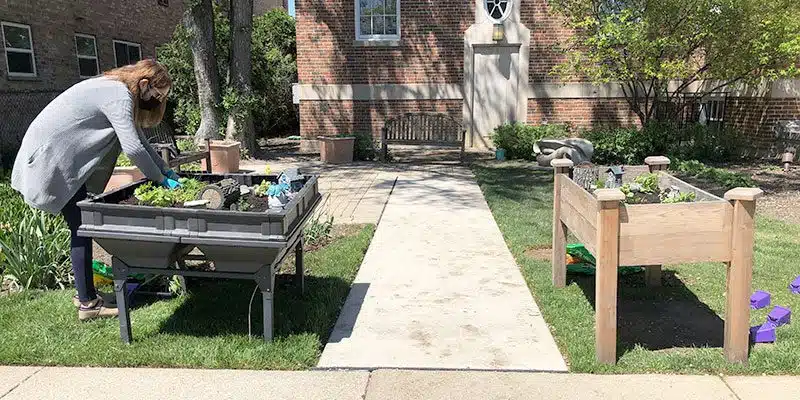
After hearing the above statistic, we developed the Community Sensory Garden at the Maze Branch Library. Communities are so much richer when everyone is involved, and so much is lost without this vibrant and vital group. We strongly believe that everyone deserves ways to engage with and be part of their community.
Gardening is a natural fit. It is age-appropriate for kids, teens, and adults, and gives disabled gardeners opportunities to make decisions and take leadership roles. There are also many health benefits, including stress relief, increased confidence, improved focus and memory, and boosted moods. It also is a calming activity that allows opportunities for nurturing and connection, and supports positive mental health.
Explore the garden
Every summer, the garden is cared for by disabled kids through monthly Supported Gardening classes. After kids tend the garden, they harvest herbs and use them in a snack they make for themselves. Community members and visitors are encouraged to help themselves to herbs any time they walk past. At the end of the season, kids harvest the remaining herbs and donate them to Beyond Hunger.
Ms. Shelley and Ms. Jenny give a garden tour:
Garden at home
The Children’s Department offers a Supported Gardening Kit that includes the same accessible garden tools that are used in classes, plus supports like gloves and kneeling pads. There is also a caregiver guide for having social-emotional learning-based conversations using the included book, Errol’s Garden.
Adam Barron, a disabled gardener with an Associate’s Degree in Ornamental Horticulture who works at Empowering Gardens, worked with us to create a video demonstrating how to use the included tools.
Conversations and communication can be hard for some disabled kids. That’s why we’ve included resources for caregivers to learn more about being a supportive communication partner: articles on pauses and waiting time, scaffolding communication supports to build independence, and more. All children have something to share, and we hope to help start some fun conversations through this experience.
Watch an unbagging of the kit:
Gardens are an outdoor classroom
In our garden classes, we often highlight math, science, and literacy.
In Plant One Seed, Grow Two Lessons, Hedda Sharapan of the Fred Rogers Center points out that there’s a social-emotional learning aspect, too. There’s waiting for things to sprout, and learning that growing takes time, but it happens even when you can’t see it. That’s challenging for kids to understand!
You don’t need a yard to grow things, either. Here’s how to grow a windowsill herb garden.
Check out these books for inspiration!
- Planting a Garden in Room 6 shows kindergartners at work in their garden: great for kids to emulate!
- Up in the Garden, Down in the Dirt is great for kids who want to know why things happen, and how.
- Garden to Table has simple recipes for good food that is easy to grow.
- Let’s Get Gardening has step-by-step directions and includes windowsill projects.
- Gardening with Emma was written by a kid for kids.
- Kids Gardening is a great website with activities and lesson plans.
- PBS has a wonderful guide about how gardening affects your brain, body, and soul, and how it’s a great bonding activity, too.

About Shelley
Shelley is a children’s librarian with a passion for early literacy, serving and celebrating the disability community, and exploring technology. She can often be found practicing storytime songs with her black lab, Bingo.