
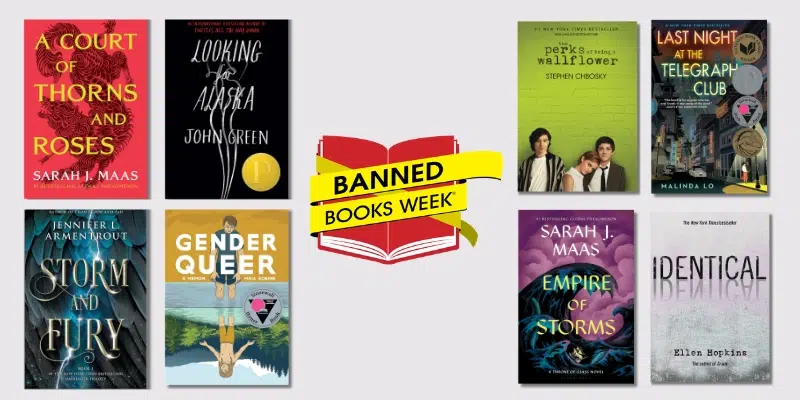
Every year during Banned Books Week (October 4-10 this year), the American Library Association (ALA) celebrates the freedom to read by recognizing books that have been challenged, censored, and banned in libraries and schools.
Check out some of the most challenged books below—and why they were challenged—from the last year (compiled from data from the ALA’s Office of Intellectual Freedom).
Our Village is a Book Sanctuary Community
In June 2023, the Village of Oak Park Board of Trustees voted to name Oak Park a Book Sanctuary Community. The resolution affirms that Oak Park champions diverse and inclusive books, and protects access to challenged and banned books.
Additionally, an Illinois state law that took effect in January 2024 discourages state libraries from removing books because of personal, political, or religious reasons.
Most challenged books in 2025
The Perks of Being a Wallflower by Stephen Chbosky
Why was it challenged, banned, and/or restricted? There is a depiction of sexual abuse, LGBTQIA+ content, drug use, and profanity, and the content has been considered to be sexually explicit.
Description: Charlie is a freshman. And while he’s not the biggest geek in the school, he is by no means popular. He’s a wallflower—shy and introspective, and intelligent beyond his years, if not very savvy in the social arts. We learn about Charlie through the letters he writes: trying to make friends, family tensions, exploring sexuality, experimenting with drugs—and dealing with his best friend’s recent suicide.
Gender Queer by Maia Kobabe
Why was it challenged, banned, and/or restricted? It contains LGBTQIA+ content and has been considered to have sexually explicit images.
Description: This autobiography by Maia Kobabe, who uses e/em/eir pronouns, charts eir journey of self-identity, which includes the mortification and confusion of adolescent crushes, grappling with how to come out to family and society, bonding with friends over erotic gay fan fiction, and facing the trauma and fundamental violation of Pap smears.
Empire of Storms by Sarah J. Maas
Why was it challenged, banned, and/or restricted? There are depictions of sexual abuse and violence, LGBTQIA+ content, and profanity.
Description: The long path to the throne has only just begun for Aelin Galathynius. Loyalties have been broken and bought, friends have been lost and gained, and those who possess magic find themselves at odds with those who don’t. As the kingdoms of Erilea fracture around her, enemies must become allies if Aelin is to keep those she loves from falling to the dark forces poised to claim her world.
Last Night at the Telegraph Club by Malinda Lo
Why was it challenged, banned, and/or restricted? Includes LGBTQIA+ representation and equity, diversity, and inclusion (EDI) content.
Description: Seventeen-year-old Lily Hu can’t remember exactly when the question took root, but the answer was in full bloom the moment she and Kathleen Miller walked under the flashing neon sign of a lesbian bar called the Telegraph Club. America in 1954 is not a safe place for two girls to fall in love, especially not in Chinatown. Red Scare paranoia threatens everyone, including Chinese Americans like Lily. With deportation looming over her father—despite his hard-won citizenship—Lily and Kath risk everything to let their love see the light of day.
A Court of Thorns and Roses by Sarah J. Maas
Why was it challenged, banned, and/or restricted? Includes LGBTQIA+ representation, profanity, and depictions of drug/alcohol use.
Description: Dragged to a treacherous magical land she only knows about from stories, Feyre discovers that her captor is not an animal, but Tamlin, a High Lord of the faeries. As her feelings toward him transform from hostility to a fiery passion, the threats against the faerie lands grow. Feyre must fight to break an ancient curse, or she will lose Tamlin forever.
Identical by Ellen Hopkins
Why was it challenged, banned, and/or restricted? It contains LGBTQIA+ representation, reproductive health content, descriptions of drug/alcohol use, and violence.
Description: Sixteen-year-old identical twin daughters of a district court judge and a candidate for the United States House of Representatives, Kaeleigh and Raeanne Gardella desperately struggle with secrets that have already torn them and their family apart.
Looking for Alaska by John Green
Why was it challenged, banned, and/or restricted? Includes LGBTQIA+ representation, reproductive health content, descriptions of drug/alcohol abuse, and suicidal ideation.
Description: Sixteen-year-old Miles’ first year at Culver Creek Preparatory School in Alabama includes good friends and great pranks, but is defined by the search for answers about life and death after a fatal car crash.
Storm and Fury by Jennifer L. Armentrout
Why was it challenged, banned, and/or restricted? Includes LGBTQIA+ representation and equity, diversity, and inclusion (EDI) content.
Description: Eighteen-year-old Trinity Marrow, who is losing her sight, has a well-kept secret. She can see and talk to the dead and must remain in a compound that is guarded by Wardens who are shape-shifting gargoyles. They must protect her from demons who want to capture her to take on her special powers. However, a new threat arrives, and Trinity joins forces with Zayne, a Warden from another clan, in order to save her family.