
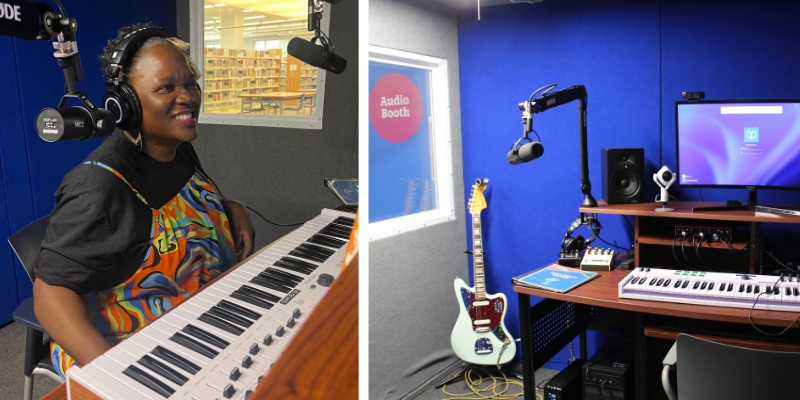
Music has always been part of Antonia Celeste Lucas-Ruppert’s life. “I call myself a gospel blues singer,” she says, tambourine in hand.
Antonia is recording an album in the Main Library Audio Booth, which she hopes to release this fall. Below, we get a look into her process and why she makes music, and we’ll also meet another Audio Booth user along the way.
‘The singing is what kept us together’
Antonia grew up singing in the church choir and taking piano lessons when she could. She inherited her love of the blues from her grandfather, and she can remember her grandmother’s voice as the whole family sang “Pray On My Child” by The Williams Brothers, a gospel group from Jackson, Mississippi.
“The singing is what kept us together,” Antonia says.
Antonia kept that mindset when her father, who loved old Southern gospel, was dying from cancer. In the year leading up to his death in 2014, she would send him recordings of herself singing into her phone.
“You know, to encourage him to keep going,” she says. “And after he passed, I kept making music.”

‘This is a gift’
This past summer, Antonia was trained to use the Audio Booth in the Main Library Creative Studio. There in the acoustically treated space, she’s been recording songs for an album, Devotions, that she hopes to release in October.
“I’ve tried so many times to get my music produced,” Antonia says. “This is a gift. I didn’t see it coming.”
In the Audio Booth, she’s playing tambourine as she sings “Lawd,” a new song that came to her in the shower.
She’s harmonizing with a voice recording from her aunt singing “Pray On My Child,” the song their family loved so much.
And in honor of her 25th wedding anniversary, she’s re-recording “Holding On to Our Love,” a song she wrote in 2023 when her and her husband’s youngest went off to college.
“It’s a win, and not just for me,” she says. “I encourage a lot of creatives to do this. This would have cost me lots and lots and lots of money and time and resources.”
Learn more about Antonia’s music, art, and more at her website.

‘You don’t need an engineering background’
Another Audio Booth user is reggae artist Robert Lewis.
“You walk in and immediately have access to professional tools,” Robert says. “All without needing a home studio or expensive gear. You don’t need to be an expert or have an engineering background. You just need curiosity and a willingness to explore.”
Get trained to use the Audio Booth
Trained users can reserve the Audio Booth once a week, for up to three hours at a time.
To get trained, you first schedule a Learning Lab appointment to go over the equipment and software with a library staff member—for example, Supervising Librarian of Creative Technology John Gargiulo, himself a guitarist who also plays mandolin and lap steel.
The Audio Booth is used a lot for podcasts, John says, “but there are a lot of music-making tools in here for people to know about.”
Music-making tools inside
Inside the booth are four microphones, which capture vocals and instruments and produce a richer sound than what you might get by recording on your phone.
There’s also an electric guitar, effect pedals, a drum machine, and a MIDI keyboard that can digitally produce the sounds of all kinds of instruments, such as organ, flute, and violin.
Plus, different digital audio workstations (DAWs) are available on the computer: REAPER, Ableton Live, and Pro Tools Studio.
“DAW subscriptions can often be cost prohibitive for individuals,” John says, “so the fact that we have access to industry-standard tools at the library for free is kind of sweet.”

‘Creativity belongs to everyone’
Access—to tools and space, without financial barriers—is why Robert has made the Creative Studio his studio.
“The Audio Booth is where the magic happens: clean vocals, warm harmonies, and everything needed to bring a song to life,” he says. “Pre-production and post-production facilities are also available through full workstations, allowing for an uninterrupted workflow.”
Robert says, for him, reggae is “a way of staying connected to something positive and steady in these very unsteady times.”
“Creativity belongs to everyone,” he adds. “You don’t need permission to make art. You don’t need credentials to express yourself. Reggae taught me that peace is a rhythm you return to. This library gave me a place to return to it.”